Blinding
In a blinded trial, some values (most often the treatment arm) must be invisible to some people while staying real, versioned, audited data. In edc-core, blinding is a flag on the item definition, enforced everywhere the value could appear, and governed by one permission. This page walks what each role sees, where the mask follows the data, and how breaking the blind is documented. The design rationale is ADR-0009.
Who does what: blinding is authored with study.manage; seeing blinded values requires the data.unblind permission, held by default by the site-facing roles (investigator, data entry, admin) and not by monitors or data managers. The screenshots use the seeded ST.BLD.DEMO study: a dosing form whose assigned-arm item is blinded, entered by demo-coord, reviewed by demo-cra (monitor), with demo-admin performing the break-the-blind action.
The model in one paragraph
An item flagged Blinded (the checkbox in the builder’s item editor, or edc:Blinded="Yes" in the ODM file) is captured, versioned, and audited exactly like any other item: blinding scopes visibility, not collection. At read time, the server checks whether the requester holds data.unblind in scope and masks the value if not. At snapshot publish, blinded columns are excluded structurally, so downstream surfaces cannot leak what they never contain.
What each role sees
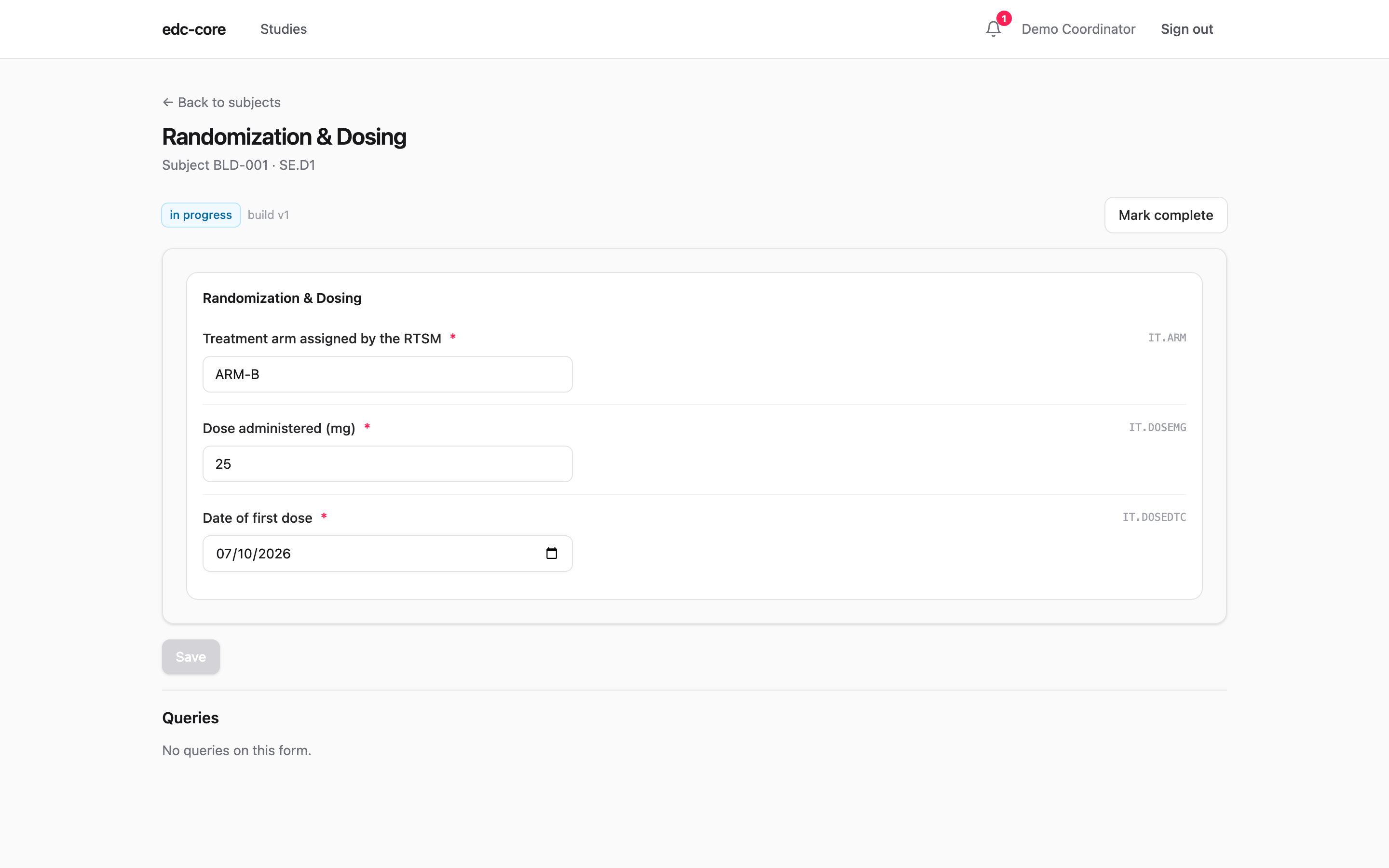
The demo study’s Day 1 form collects the RTSM-assigned arm (blinded) and the administered dose. The site coordinator, holding data.unblind as an entry role, sees a normal form; entering a dose next to a visible arm feels like entering anything else:
The monitor opens the same form and sees the item’s presence and entry status, but never its value:
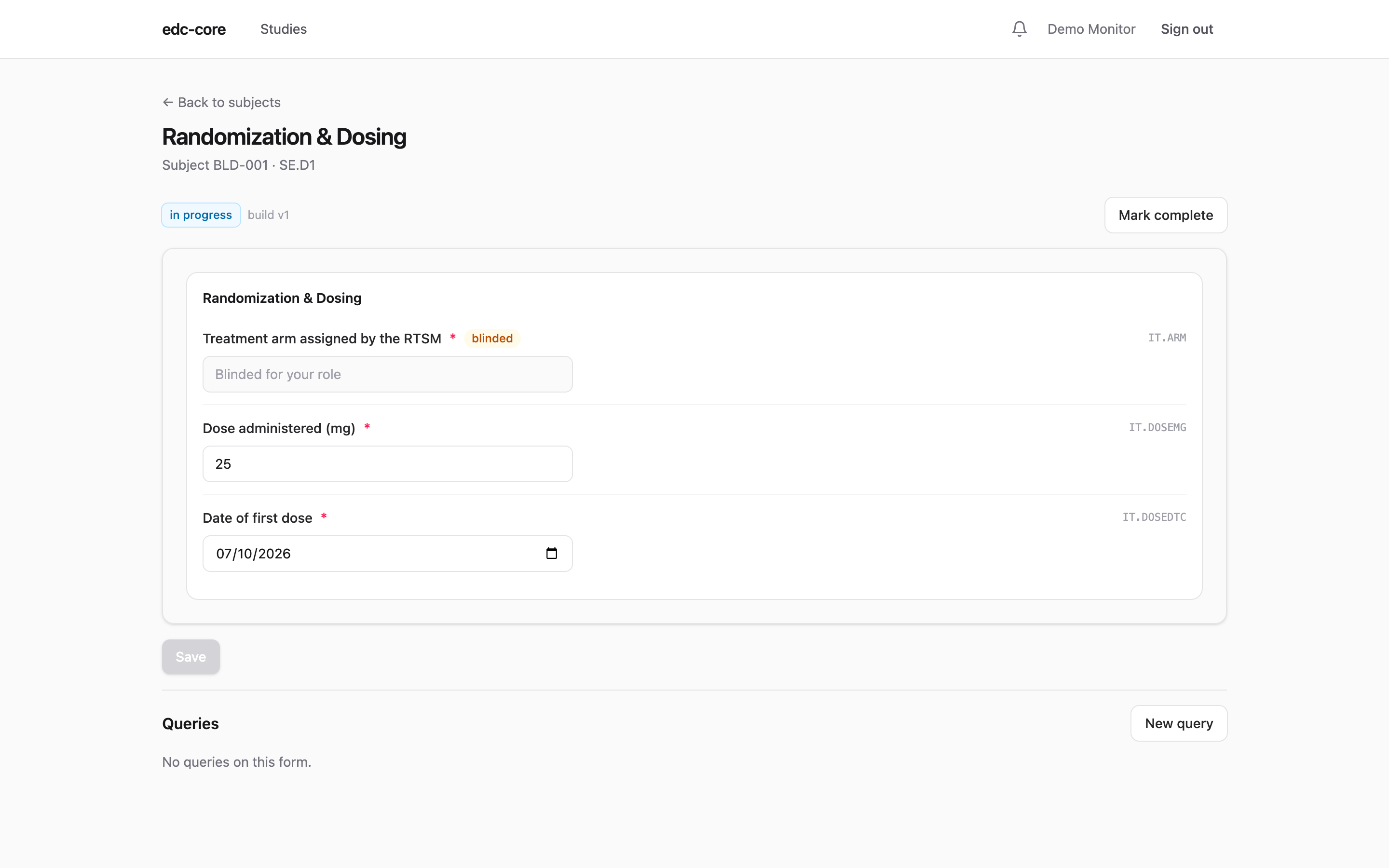
That is the whole user-facing contract: the blinded reviewer can still verify the form was filled, query it, and see that the arm changed in the audit trail, without ever learning what it says.
Everywhere the mask follows
The same rule applies wherever the value could travel:
- Casebooks print
[BLINDED]unless the requester can unblind; study archives always use the blinded rendering. - Audit review shows blinded reviewers who changed the item, when, and why, with old and new values masked.
- Analytics snapshots never contain blinded columns at all, so the SQL, R, and Python workbench and every export are blinded by construction; the snapshot manifest lists the excluded items.
- The RTSM transfer log masks the arm and strata for viewers without a study-wide
data.unblindgrant.
Breaking the blind
Emergencies happen, and ICH E6(R3) expects each unblinding event to be documented. In edc-core that is a first-class action on the subject matrix: Break the blind… on the subject’s status menu, taking a category (planned, or unplanned: emergency, inadvertent, other) and a required reason.
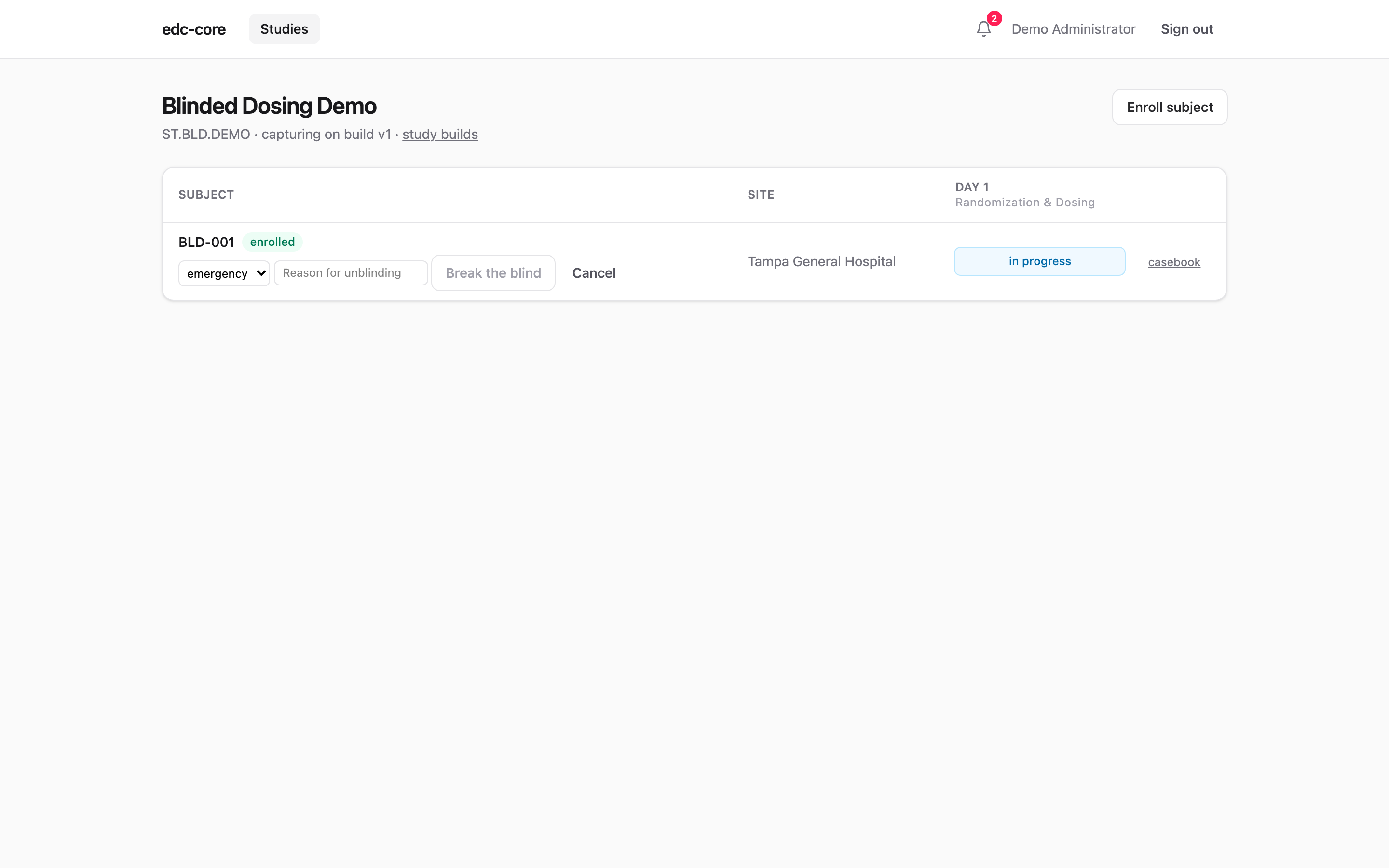
The action writes an append-only subject.unblinded audit event and marks the subject with an unblinded badge, and the event prints in the subject’s casebook. Two boundaries are deliberate:
- Breaking the blind is documentation, not a switch. Masking stays governed by
data.unblindgrants; one subject’s emergency unblinding must not unmask them for every viewer. Who needed to see the value gains the grant through the team page, auditable like any grant. - Emergency code-break workflows stay in the RTSM, which holds the randomization list. edc-core records that an unblinding happened and why.
Governance
Access to blinded data is a grant, not a setting. The team page shows who holds data.unblind, at what scope, granted when and by whom; revoking it takes effect immediately. System administrators deliberately have no bypass: without a study role carrying the permission, an administrator sees [BLINDED] like any other viewer. For E6(R3) §4.1 purposes, the grant history is the record of who could see unblinded data and when, and the break-the-blind events are the record of each unblinding; assessing an unplanned unblinding’s impact on trial results remains your organization’s call.
Where next
- RTSM integration: how the arm arrives without a human ever typing it.
- Data capture: the entry-side summary.
- User administration: granting and revoking
data.unblind.