Operational layer
The features CTMS products sell (monitoring visits with trip-report workflows, issue and deviation tracking, enrollment metrics, milestones) are usually built as workflow objects: rows with status columns advanced by application code, in modules vendors configure per customer. That design is why incumbent systems are hard for data teams to use: the workflow state lives in vendor-specific objects reachable only through vendor screens and vendor exports.
ctms-core builds the same features the other way around. Tables store dated facts; views derive the lifecycle. No table in this layer has a status column, so a stage can never be stale: it is never written, only computed.
This page explains how the operational layer is built. The same workflows as step-by-step tasks in the app (scheduling visits, logging deviations, reporting enrollment) live in the user guide.
Monitoring visits
A monitoring_visit records the facts of a visit at a study-site: type (pre_study | initiation | interim | close_out), the scheduled date, the actual visit date (null until conducted), the monitor, and a summary.
Everything else is derived. v_monitoring_visit_status computes the stage from the dates, the linked trip report’s document status, and open action items:
| Stage | Meaning |
|---|---|
scheduled |
Scheduled date in the future, not yet conducted |
overdue |
Scheduled date has passed with no visit date recorded |
awaiting_report |
Conducted, but no trip report yet, or the report was returned for correction (ADR-0015) |
report_pending_review |
Trip report uploaded, awaiting approval signature |
follow_up |
Report approved, but action items remain open |
complete |
Report approved and every action item resolved |
The stage machine is fixed in the view, deliberately: new stages are a migration, not a per-customer workflow configuration.
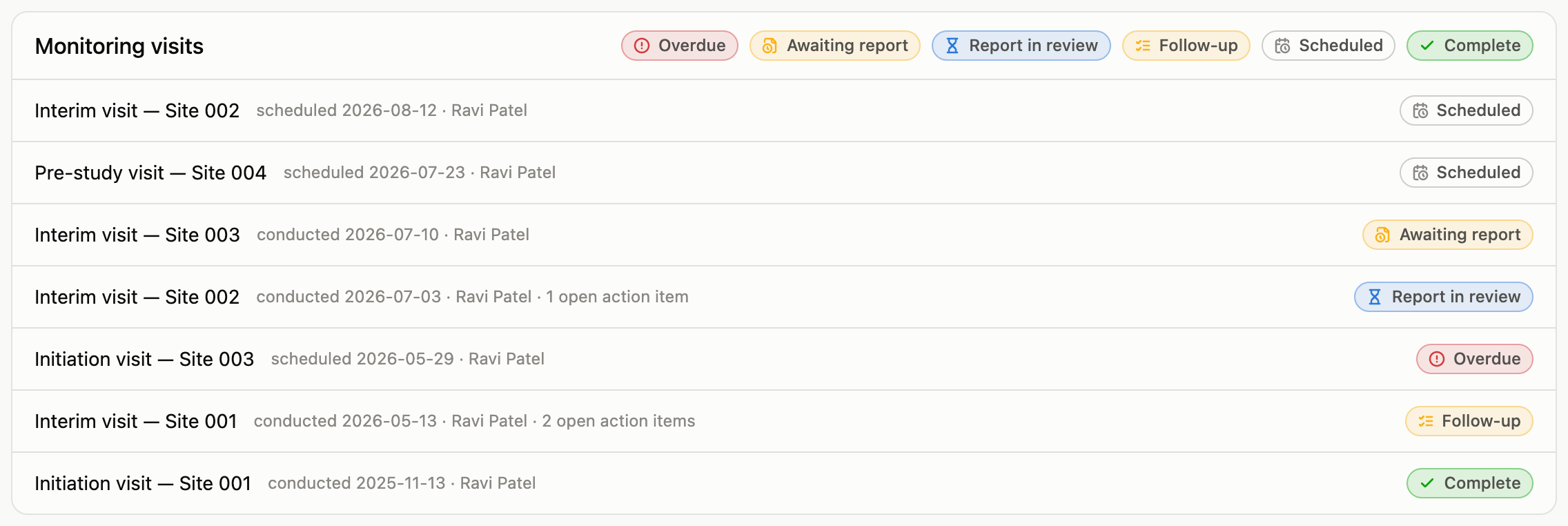
v_monitoring_visit_status and one-click stage filters (URL-addressable, like everything else).Trip reports are documents, not a parallel review system
Visit documents (trip reports, confirmation letters, follow-up letters) are ordinary documents linked to the visit through a typed join table. They get the same immutable versions and hash-bound signatures as everything else. “Report approved” is an ordinary approval signature, which is what moves the visit past report_pending_review, and “report returned” is an ordinary return-for-correction (ADR-0015), which drops the visit back to awaiting_report until a corrected report is uploaded.
One wrinkle worth knowing: two visits at the same site produce documents with identical artifact and scope, so visit-linked documents are treated as per-visit records. Uploading through the visit endpoint always creates a fresh document, and the usual supersede-siblings step on approval skips visit-linked documents in both directions. Visit 2’s trip report never supersedes visit 1’s.
Action items
visit_action_item rows are findings to close out: a description, a due date, and resolution fields (resolved_at, resolver, note). Open action items hold the visit in follow_up even after the report is approved; closing them out is what completes the visit.
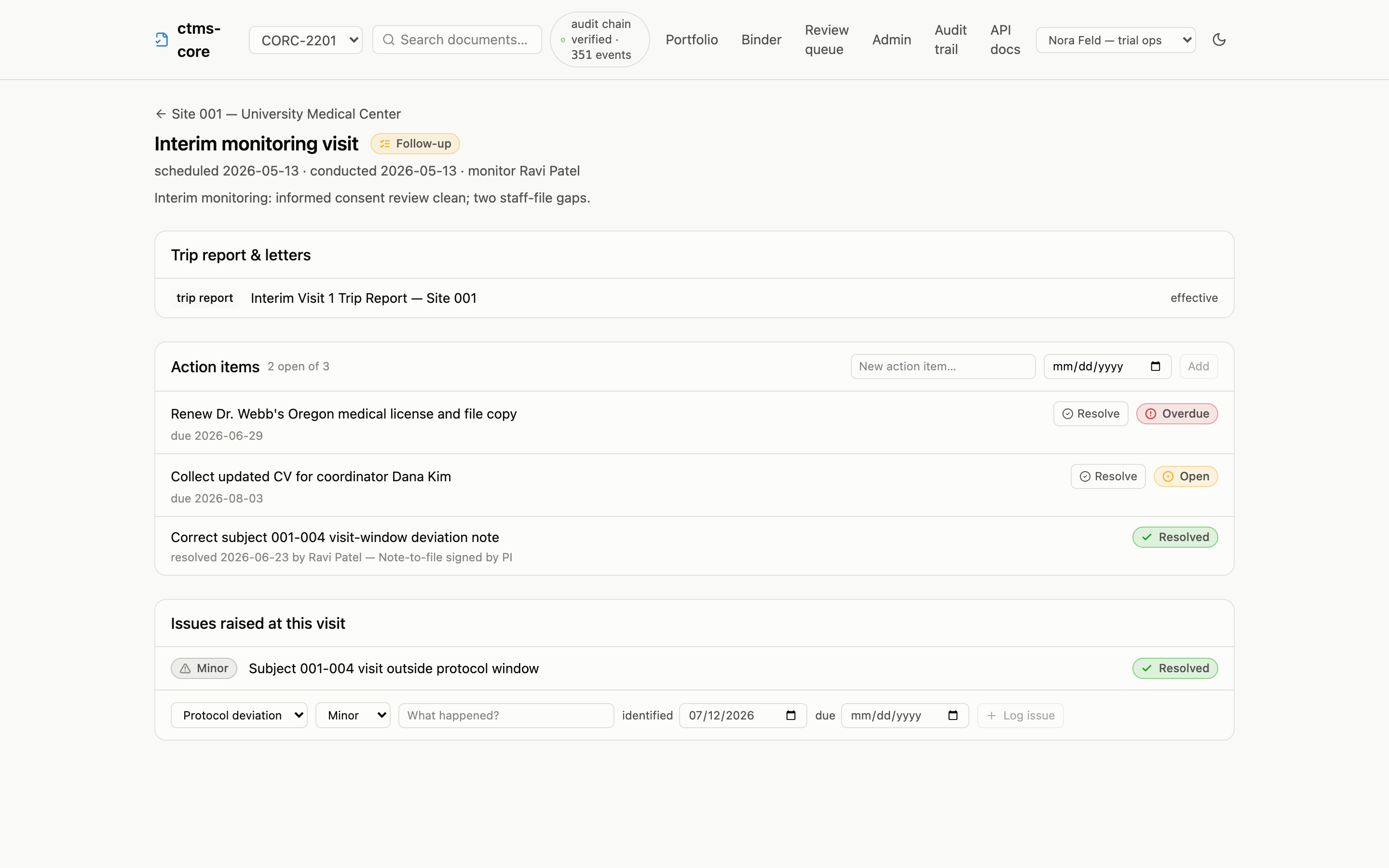
follow_up: the trip report is effective, but one action item is overdue and another open; resolving them is what moves the visit to complete.Issues and deviations
An issue is a protocol deviation or finding, scoped to the study or to a site, optionally linked to the monitoring visit that identified it. Facts: category, severity (minor | major | critical), identified date, due date, resolution date and note.
v_issue_status derives open | overdue | resolved from the dates. An issue past its due date without a resolution is overdue; nobody has to remember to flip a flag.
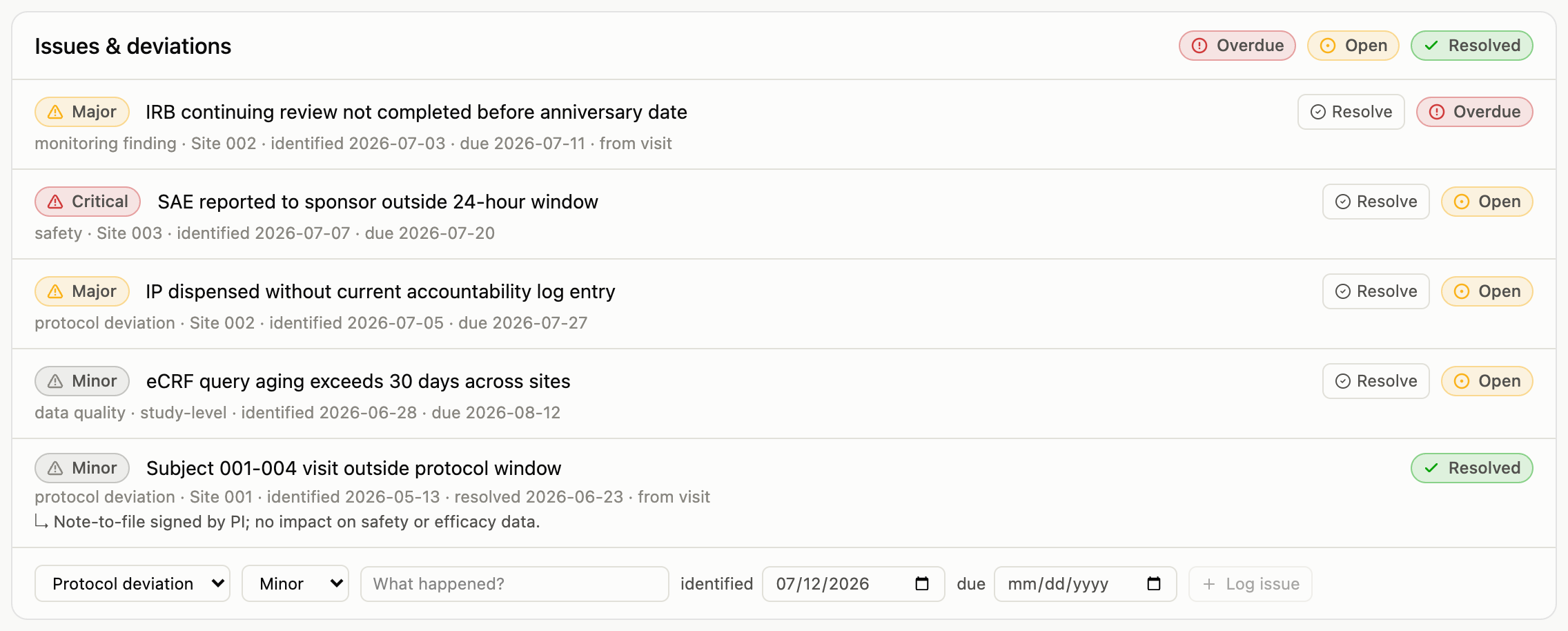
POST), and the user guide walks it.Enrollment
enrollment_report holds site-reported aggregates, one row per site and as-of date: screened, enrolled, withdrawn, completed. v_site_enrollment surfaces the latest report per site against the site’s target.
This is a firm scope boundary, not a phase-1 shortcut. ctms-core carries operational aggregates for oversight; the EDC owns the clinical record.
Corrections to a report are audited UPDATEs rather than new rows or silent overwrites; the audit trail preserves full before/after row images.
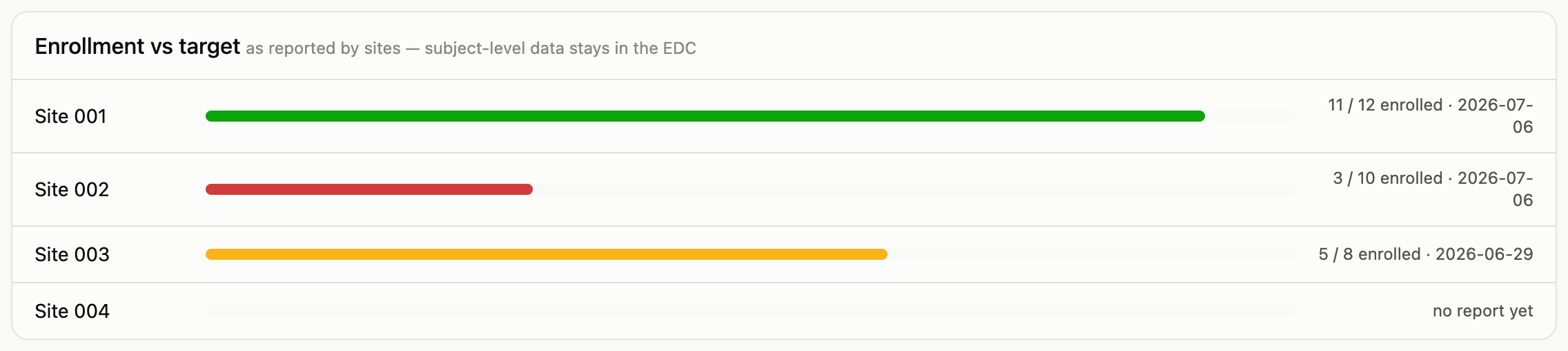
v_site_enrollment: the latest report against study_site.target_enrollment.Milestones
study_milestone rows carry planned and actual dates, scoped to the study or a site. v_milestone_status derives achieved | overdue | upcoming, which makes drift between plan and reality a query.
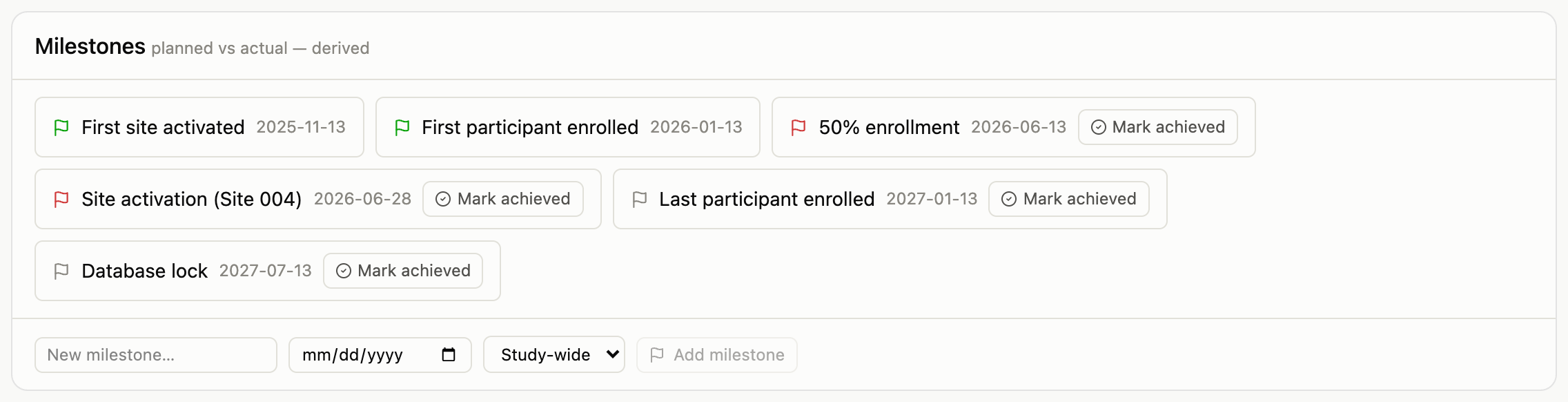
v_milestone_status.Corrections and the audit trail
Unlike document versions and signatures, operational tables carry no immutability triggers: visits get rescheduled, counts get corrected, items get edited. These are correctable operational facts. What makes that safe is that the same trigger-written, hash-chained audit trail records every change with full before and after images. Deleting a mis-scheduled visit leaves an audited tombstone rather than a silent gap.
Digest notifications
Nothing here requires anyone to remember to look: pnpm digest (ADR-0017) emails each study’s oversight summary (expiring and expired documents, overdue visits, action items, issues, milestones, and overdue review assignments, with a broken audit chain leading the message) to everyone holding study-wide admin or trial-ops access. The digest is a pure function of the same derived views the dashboard reads, computed at send time: no notification state, no subscription list, nothing that can drift from the record. Schedule it with cron at whatever cadence the team wants, either from a checkout or against the production compose stack (docker compose -f compose.prod.yaml run --rm api pnpm digest; the api image ships the tools). SMTP_URL names the relay (the dev stack ships mailpit on smtp://localhost:1025, inbox UI on :8025), and without it the job prints to stdout. It connects as the same least-privilege database role the API uses.
Handing over the TMF
When the study transfers, archives, or gets inspected, pnpm export-tmf (ADR-0020) writes one verifiable package: every document version’s bytes (named by their sha256), the full metadata (signatures carrying the exact content hash they signed, returns, waivers, the completeness snapshot), and the entire hash-chained audit trail. The receiving party checks it with nothing but shasum -a 256 -c manifest.sha256; a single altered byte fails.
Adding --ems <agreement-id> (ADR-0024) puts a CDISC eTMF-EMS v1.0.2 exchange.xml in the package: the industry interchange inventory, one <OBJECT> per document version, validated against the official schema on every export. The agreement id is the SPECIFICATIONID of the exchange agreement between the parties; there is no default, because an export cannot claim an agreement nobody made. EMS output requires the verbatim TMF Reference Model import (pnpm db:import-tmf): the standard’s mandatory unique IDs and model version are read from the licensed spreadsheet, never invented, and the export refuses, naming every gap, until they are on record.
Receiving a partner’s TMF
The exchange works in both directions (ADR-0025). pnpm import-ems -- --package <dir> reads a partner’s eTMF-EMS package and files it through the same audited endpoint every source system uses (ADR-0011), as an ingest machine identity. The standard’s receiving-side checks run first (XSD validation, checksum verification of every file), and the batch refuses as a whole, every blocker named at once, when anything cannot be mapped honestly: a TMF RM unique ID the imported taxonomy doesn’t know, a site the study doesn’t have, a country-level or RESTRICTED object the schema can’t hold. What files lands pending_review; nothing becomes effective without a human. Re-running the same package files nothing (the importer asks the API what it already filed), and the partner’s own signatures and audit records stay in the retained package as their testimony, never replayed into this system’s record.
Reading it all from code
Every capability here ships in the OpenAPI spec, and the four v_* views are public query surface for direct SQL. The cookbook’s “CRA’s week” walks through visits needing attention, open action items, unresolved deviations, enrollment vs target, and milestone drift, each one a flat data frame.