erDiagram
    tmf_zone ||--o{ tmf_section : contains
    tmf_section ||--o{ tmf_artifact : contains
    organization ||--o{ study : sponsors
    organization ||--o{ site : operates
    study ||--o{ protocol_version : versions
    study ||--o{ study_site : enrolls
    site ||--o{ study_site : participates
    study_site ||--o{ study_site_role : staffs
    person ||--o{ study_site_role : holds
    tmf_artifact ||--o{ document : types
    study ||--o{ document : scopes
    study_site o|--o{ document : scopes
    person o|--o{ document : scopes
    document ||--o{ document_version : versions
    document_version ||--o{ signature : signs
    person ||--o{ signature : signer
    person ||--o{ access_grant : authorizes
    study o|--o{ access_grant : scopes
    study_site o|--o{ access_grant : scopes
    tmf_artifact ||--o{ requirement_rule : requires
    study ||--o{ requirement_rule : configures
    requirement_rule ||--o{ expected_document : materializes
    study_site ||--o{ monitoring_visit : hosts
    monitoring_visit ||--o{ monitoring_visit_document : links
    document ||--o{ monitoring_visit_document : linked
    monitoring_visit ||--o{ visit_action_item : raises
    study ||--o{ issue : tracks
    study_site o|--o{ issue : scopes
    monitoring_visit o|--o{ issue : identifies
    study_site ||--o{ enrollment_report : reports
    study ||--o{ study_milestone : plans
    study_site ||--o{ delegation : logs
    person ||--o{ delegation : delegate
    person ||--o{ delegation : authorizes
    study_site ||--o{ training_record : logs
    person ||--o{ training_record : trainee
    document o|--o{ training_record : certifies
Data model
Postgres is the system of record. Everything the dashboard shows and the API serves is either a table of facts or a view derived from those facts. There is no third category, and no stored status column anywhere in the system.
Reference taxonomy
tmf_zone → tmf_section → tmf_artifact mirror the CDISC TMF Reference Model hierarchy (11 zones of numbered sections and artifacts in the official model).
The seeded taxonomy is an illustrative subset
The seed contains roughly 40 hand-checked artifacts across the major zones (Trial Management, Regulatory, IRB/IEC, Site Management, IP, Safety), enough to exercise every mechanism, deliberately not a reproduction of the full model. Artifact numbering follows the official scheme (e.g. 03.01.02), and pnpm db:import-tmf loads the complete CDISC spreadsheet verbatim: download it from CDISC yourself (licensing) and the importer upserts by artifact number, no schema change.
Organizational spine
- organization: sponsor, CRO, or site institution.
- study: protocol number, title, phase; belongs to a sponsoring organization.
- protocol_version: labeled versions with effective dates. Requirement rules can demand re-collection per version (amended protocol signature pages, for instance).
- site and study_site: a physical site, and its participation in a study: site number, lifecycle (
pending → active → closed), activation date, enrollment target. Most site-level documents hang offstudy_site. - person and study_site_role: people, and the roles they hold at a study-site (PI, sub-investigator, coordinator, pharmacist, research nurse) with start and end dates. Role assignments are auditable facts and the anchor for person-scoped requirements. These are persons, not “users”. Login identity maps onto persons at the API layer, so the identity provider is swappable without touching the regulated facts.
- access_grant: what a person may do through the API: a role (
admin | trial_ops | monitor | read_only | ingest | site_staff), optionally scoped to one study or one study-site, mapping to operations (read / upload / sign / approve / administer / log).site_staffis the site seat (ADR-0023): a person whose every grant is site-scoped works entirely through their site’s page, andloggates writing that site’s own DoA/training entries. Revocation is a timestamp, never a delete, and every grant change lands in the audit trail, so an access review is a query. Deliberately separate fromstudy_site_role, which records regulated staffing facts.
Documents
- document: one logical record: its TMF artifact type plus scope columns (
study_idalways;study_site_idfor site-scoped;person_idfor person-scoped, which requires site scope too, since a CV is filed per site). Lifecyclestatus:pending_review → effective → superseded, with areturneddetour when review sends a version back (ADR-0015), and optional effective and expiry dates for licenses, approvals, and training certificates. - document_version: immutable; the database rejects UPDATE and DELETE for every role. Each version records number, sha256 of the content, filename, MIME type, size, uploader, timestamp, and, when a source system filed it,
source_system/source_refprovenance (ADR-0011). File bytes live in a content-addressed store keyed by that hash: a local directory in dev, or S3 with Object Lock so the bytes are WORM (ADR-0009). Duplicate uploads deduplicate for free. - signature: a Part 11 e-signature record: signer, meaning (
author | review | approval), timestamp, andsigned_sha256, a copy of the version’s content hash taken at signing, so the signature↔︎record binding (§11.70) is verifiable independently of the version row. Each signature also records how and when the signer re-authenticated (§11.200); a database CHECK requires it on every new row. Immutable, like versions. - document_return: the review outcome besides approval (ADR-0015): who returned a version, when, and why. The reason is required and non-blank at the schema level, the row is immutable like a signature, and a returned version can never be approved; the fix is a corrected version, which reopens review.
Finding a document is a query too (ADR-0019): v_document_search flattens each document’s metadata (title, artifact taxonomy, site, person, uploader, file names, filing source) into a searchable haystack, and search requires every word to match. There is no search index that could drift from the record. The view also carries each document’s extracted text (ADR-0022): document_content_text holds the text of every stored blob, keyed by the same content hash as the blob store. It is derived state deliberately outside the audited record, since extracted text of immutable bytes can never go stale and can be rebuilt from the bytes at any time (pnpm db:extract-text). So a search word can match what a document says, not only what it is filed as.
Review work is routed the same way (ADR-0018): a review_assignment row names who should review a pending version and when it is due, with no status column: the assignment is finished exactly when its version gains an approval signature or a return, and v_review_queue derives unassigned | assigned | overdue for everything still waiting. Approving or returning is what empties the queue; there is no completion flag to forget.
The requirement engine
- requirement_rule: declarative, per study: which artifact, at which scope level (
study | study_site | person_role), for which roles when person-scoped, how many months a document stays valid (null = never expires), and whether a signature is required. - expected_document: placeholders materialized from the rules: one row per rule × in-scope entity (the study; each active study-site; each active matching role assignment). An idempotent sync inserts missing placeholders and removes unfulfilled ones whose scope entity has left (a role ended, a site closed).
- expected_document_waiver: why an expected document is not applicable (ADR-0016): reason (required, non-blank), who, when. Lifting a waiver sets the revoke fields once (a recorded fact, never a delete), and one active waiver is allowed per placeholder.
- v_expected_document_status (view): the heart of the system. Joins each placeholder to its best fulfilling document (same artifact and scope, latest effective) and its active waiver, and derives status:
missing | waived | pending_review | returned | current | expiring_soon (≤60 days) | expired | superseded.waivedappears exactly wheremissingwould have; a filed document always wins over a waiver. - v_study_site_completeness (view): the per-site rollup: counts by status, percent current. Waived rows leave the percentage’s denominator: an explained absence is not a gap.
Because no stored status exists, completeness is computed from ground truth on every read. It cannot drift from the documents, which is the failure mode this project exists to fix.
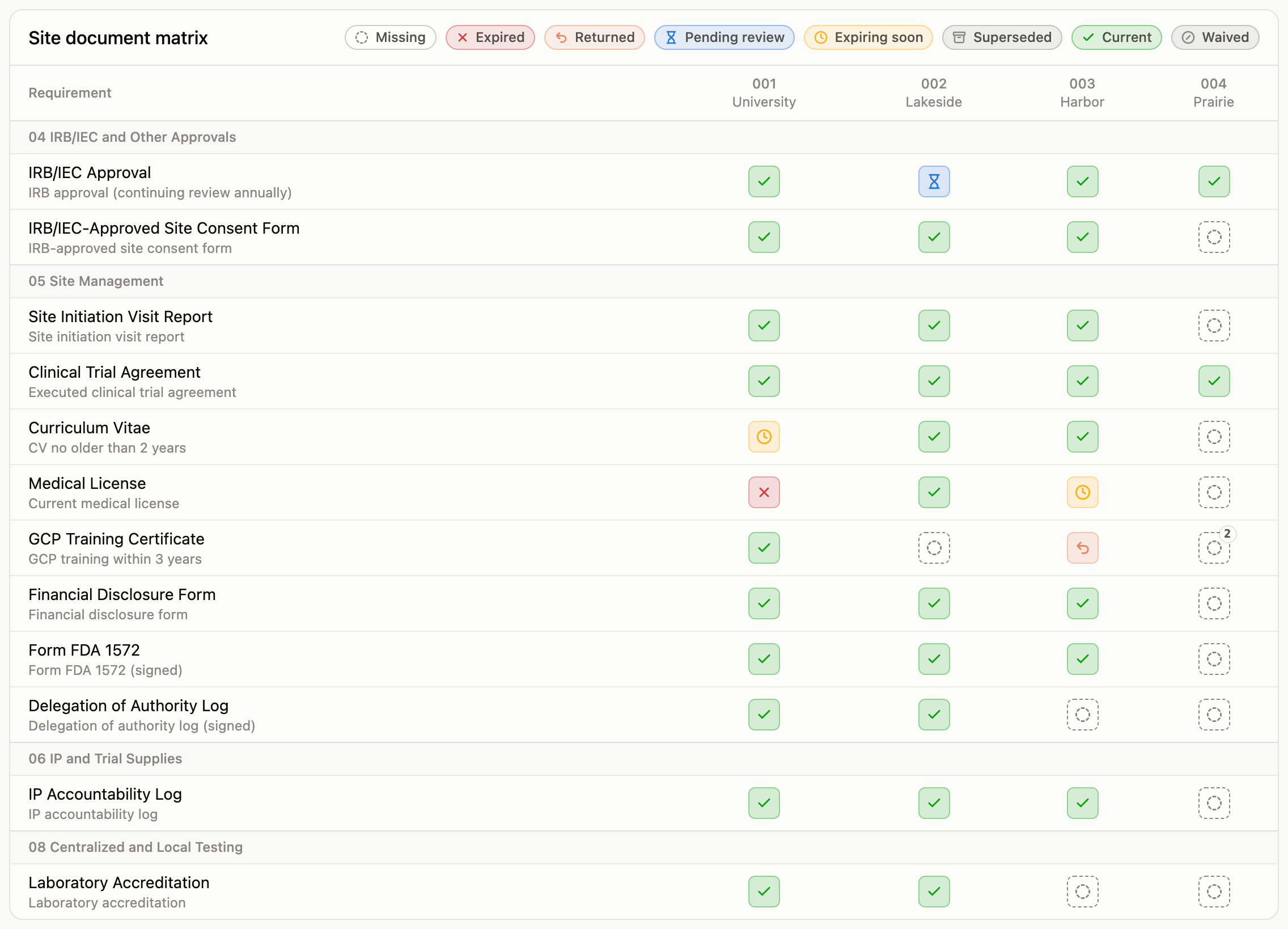
SELECT from v_expected_document_status: requirements down, sites across, every cell a derived status.The operational layer
Monitoring visits, issues, enrollment, and milestones follow the same rule: facts in tables, lifecycle in views. The operational layer guide covers them in full; the derived views are v_monitoring_visit_status, v_issue_status, v_site_enrollment, and v_milestone_status.
The site-seat logs (ADR-0023) extend the same pattern to the site’s own records: delegation (delegate, delegated tasks, start/end dates, authorizing PI; CHECKs forbid self-delegation and unordered dates) and training_record (person, topic, completion date, optional expiry and a link to the filed certificate document). v_delegation_log derives active | ended plus two cross-checks: whether the authorizer held an active PI role at that site on the start date, and the delegate’s count of open credential items from v_expected_document_status. v_training_log derives current | expiring_soon (≤60 days) | expired. The signed DoA log document stays the authoritative Part 11 record; these rows are the queryable layer beside it.
Audit trail
audit_event is append-only and written by database triggers on every INSERT, UPDATE, and DELETE to domain tables, not by application discipline. Each event captures the acting person (bound per transaction by the API), the action, entity type and id, full before/after row images, a timestamp, and a hash chain: each event’s hash is computed in-database from the previous hash plus the event’s canonical fields. Any retroactive edit breaks every subsequent hash, so tampering is detectable by walking the chain. An endpoint does exactly that (GET /audit-chain/verify).
UPDATE and DELETE on audit_event itself raise an error at the database level, for every role including the owner. “Record changes shall not obscure previously recorded information” (§11.10(e)) is a property of the schema, not a code path.
Views are public API
The v_* views are not internals. They are the documented, stable query surface: the REST API is SELECTs over these views, so a data scientist with a read-only Postgres connection reads the same derived truth the dashboard shows. The two can never disagree.
Treat view columns like endpoint fields: additive changes are safe; renames and removals are breaking. Direct SQL access shows how to connect.
Where the definitions live
For the exact DDL: tables are defined in packages/db/src/schema.ts (Drizzle), and everything Drizzle can’t express (audit triggers, immutability guards, the derived-status views) lives in the SQL migrations alongside it.