API cookbook
The API is the product, and this page is its acceptance test: if the questions a monitoring team asks aren’t a few lines each, the design has failed. The examples run against the seeded demo study (pnpm db:seed) with the dev tokens from .env.example. The full interactive reference lives at http://localhost:8787/docs while the stack is running. The point-and-click versions of these same tasks are in the user guide.
Everything below is shown in R first (the stack these docs assume you might share), then condensed in Python and curl. No client library is required in any language: it’s plain HTTP with a bearer token.
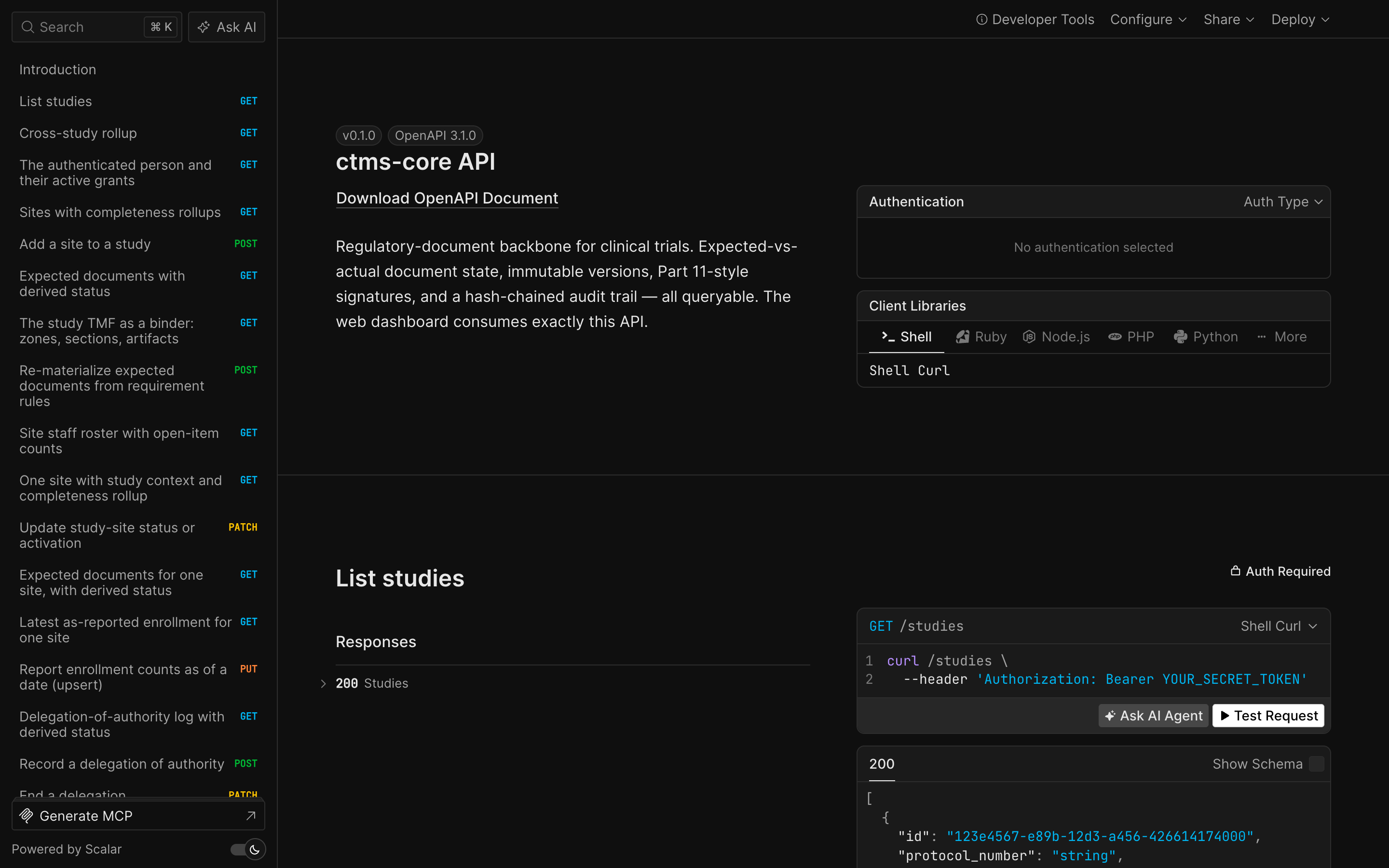
/docs, generated from the same schemas that validate requests; every endpoint has a try-it panel and client snippets.Setup
A four-line helper turns any GET endpoint into a tibble:
library(httr2)
library(dplyr)

ctms <- function(path, ..., query = list()) {
  request("http://localhost:8787") |>
    req_url_path_append(path, ...) |>
    req_url_query(!!!query) |>
    req_auth_bearer_token("dev-monitor-token") |>
    req_perform() |>
    resp_body_json(simplifyVector = TRUE) |>
    as_tibble()
}

df_studies <- ctms("studies")
study <- df_studies$id[1]
The monitor’s morning
Expected-vs-actual for the whole study, as one tidy data frame. Status is computed by the database view on every read; there is no stored flag to go stale.
df_expected <- ctms("studies", study, "expected-documents")

# Everything that needs attention, most urgent first
df_expected |>
  filter(status != "current") |>
  arrange(factor(status, c("expired", "missing", "pending_review", "expiring_soon"))) |>
  select(site_number, artifact_name, person_family_name, status, effective_expiry)

# Completeness by site, one line each
ctms("studies", study, "sites") |>
  select(site_number, site_name, pct_current, missing_count, expired_count)

# Credential expirations in the next 60 days — the report the binder systems can't run
df_expected |>
  filter(status == "expiring_soon", scope_level == "person_role") |>
  select(site_number, person_family_name, artifact_name, effective_expiry)
No pagination-by-folder, no per-document round trips, no XML exports: the completeness of a four-site trial is three GETs.
Writing: upload and sign
Mutations use the same API the dashboard does. Every write is attributed to the token’s person and lands in the hash-chained audit trail.
# Upload a missing GCP certificate (multipart; lands as pending_review)
request("http://localhost:8787/documents") |>
  req_auth_bearer_token("dev-admin-token") |>
  req_body_multipart(
    file            = curl::form_file("gcp_certificate.pdf"),
    tmf_artifact_id = artifact_id,     # from the expected-documents row
    study_id        = study,
    study_site_id   = site_id,
    person_id       = person_id,
    title           = "GCP Certificate — Oduya"
  ) |>
  req_perform()

# Approve: a Part 11 signature bound to the version's content hash.
# Signing requires re-authentication (§11.200): in dev mode the bearer token
# restated; in oidc mode a freshly issued token from the identity provider.
request("http://localhost:8787") |>
  req_url_path_append("document-versions", version_id, "sign") |>
  req_auth_bearer_token("dev-admin-token") |>
  req_body_json(list(meaning = "approval", reauth_token = "dev-admin-token")) |>
  req_perform()
Approval moves the document to effective and (outside of visit-linked documents) supersedes its predecessors, at which point the expected-document view flips from pending_review to current on its own, because it was never anything but a query.
approval is one of three signature meanings. author and review record attestations on a version without changing its status; only approval makes it effective. All three are Part 11 signatures: signer, timestamp, and meaning, bound to the content hash.
Review has a second outcome: return the version for correction with a documented reason (ADR-0015). The reason is an immutable fact row, the document shows returned until a corrected version arrives, and the returned version itself can never be approved. Returning takes the same approve permission as approving, but it isn’t a signature, so no re-authentication.
Both outcomes also work over a selection (ADR-0026): POST /document-versions/bulk-approve with version_ids and one reauth_token executes a §11.200(a)(1)(i) series of signings (one re-authentication, then one signature per version, each bound to its own content hash), and POST /document-versions/bulk-return shares one documented reason. All-or-nothing: anything unreviewable in the selection refuses the whole call with every blocker listed.
request("http://localhost:8787") |>
  req_url_path_append("document-versions", version_id, "return") |>
  req_auth_bearer_token("dev-admin-token") |>
  req_body_json(list(reason = "Unsigned copy — please upload the signed version.")) |>
  req_perform()
Filing from another system
Source systems (an EDC first) file documents through the same endpoint, with two optional provenance fields:
# ... the same multipart upload, plus:
    source_system = "edc-core",
    source_ref    = "casebook 002-011"
The version lands as pending_review like any upload (a human still approves), and its row on the document page carries a “filed by edc-core” chip. Machine identities hold the ingest role: read and upload, never sign (see ADR-0011).
The filing surface is complete enough to build an idempotent integration on (ADR-0025): force_new = "true" creates a fresh document even when a non-superseded one with the same artifact and scope exists (an imported partner record must not merge into a local one), POST /documents/{id}/versions appends a version to exactly that document (a superseded document answers 409), and GET /studies/{id}/filings?source_system= returns what that source already filed, so a re-run skips instead of duplicating. The eTMF-EMS importer (pnpm import-ems, operations) is exactly such a client and nothing more.
The CRA’s week
The operational layer answers the questions a monitor plans a week around, with every lifecycle stage derived, never stored. List endpoints filter server-side.
# Visits needing attention: overdue, or conducted without a trip report
bind_rows(
  ctms("studies", study, "monitoring-visits", query = list(stage = "overdue")),
  ctms("studies", study, "monitoring-visits", query = list(stage = "awaiting_report"))
) |>
  select(site_number, visit_type, scheduled_date, visit_date, stage)

# Open action items roll up on the same view the visit page uses
ctms("studies", study, "monitoring-visits") |>
  filter(open_action_items > 0) |>
  select(site_number, visit_type, open_action_items, stage)

# Unresolved major/critical issues, most urgent first
ctms("studies", study, "issues") |>
  filter(status != "resolved", severity %in% c("major", "critical")) |>
  arrange(desc(status == "overdue"), due_date) |>
  select(site_number, category, severity, title, due_date, status)

# Enrollment vs target — which site gets the recruitment call
ctms("studies", study, "enrollment") |>
  select(site_number, enrolled, target_enrollment, pct_of_target, as_of_date)

# Milestones: planned vs actual, drift visible
ctms("studies", study, "milestones") |>
  select(name, site_number, planned_date, actual_date, status)
Recording work is the same shape, whether you schedule a visit, log a deviation, or report counts:
# Log a protocol deviation with a 14-day resolution window
request("http://localhost:8787") |>
  req_url_path_append("studies", study, "issues") |>
  req_auth_bearer_token("dev-admin-token") |>
  req_body_json(list(
    study_site_id   = site_id,
    category        = "protocol_deviation",
    severity        = "major",
    title           = "Dosing outside window, subject 002-011",
    identified_date = as.character(Sys.Date()),
    due_date        = as.character(Sys.Date() + 14)
  )) |>
  req_perform()

# Report this week's enrollment counts for a site
request("http://localhost:8787") |>
  req_url_path_append("study-sites", site_id, "enrollment") |>
  req_auth_bearer_token("dev-admin-token") |>
  req_method("PUT") |>
  req_body_json(list(
    as_of_date = as.character(Sys.Date()),
    screened = 14, enrolled = 9, withdrawn = 1, completed = 2
  )) |>
  req_perform()

# Reschedule an overdue visit — PATCH the fact, the stage recomputes
request("http://localhost:8787") |>
  req_url_path_append("monitoring-visits", visit_id) |>
  req_auth_bearer_token("dev-admin-token") |>
  req_method("PATCH") |>
  req_body_json(list(scheduled_date = as.character(Sys.Date() + 21))) |>
  req_perform()

# Attach an already-filed document to a visit (confirmation or follow-up letter)
request("http://localhost:8787") |>
  req_url_path_append("monitoring-visits", visit_id, "document-links") |>
  req_auth_bearer_token("dev-admin-token") |>
  req_body_json(list(document_id = document_id, link_kind = "follow_up_letter")) |>
  req_perform()
The same PATCH records the visit’s conducted date, monitor, and summary; link_kind is trip_report, confirmation_letter, or follow_up_letter.
The admin corner
Site onboarding is a write surface, not a seed script (ADR-0016): create the org and site, link the site to the study, activate it, add people, assign roles, grant access, every step an audited row. The user guide covers the same flow in the app.
adm <- function(path, body) {
  request("http://localhost:8787") |>
    req_url_path_append(path) |>
    req_auth_bearer_token("dev-admin-token") |>
    req_body_json(body) |> req_perform() |> resp_body_json()
}

org  <- adm("organizations", list(name = "Cascade Clinical Research", kind = "site_org"))
site <- adm("sites", list(organization_id = org$id, name = "Cascade Clinical Research",
                          city = "Boise", state = "ID"))
ss   <- adm(paste0("studies/", study, "/sites"),
            list(site_id = site$id, site_number = "005"))
pi   <- adm("people", list(given_name = "Ada", family_name = "Okafor",
                           email = "ada.okafor@cascade.example", credentials = "MD"))
adm(paste0("study-sites/", ss$id, "/roles"),
    list(person_id = pi$id, role = "principal_investigator",
         start_date = as.character(Sys.Date())))
adm("access-grants", list(person_id = pi$id, role = "read_only", study_id = study))
When requirement rules or staff role assignments change, an admin re-materializes the expected-document placeholders. The sync is idempotent: it inserts what’s newly expected and prunes unfulfilled placeholders that no longer apply.
request("http://localhost:8787") |>
  req_url_path_append("studies", study, "sync-expected-documents") |>
  req_auth_bearer_token("dev-admin-token") |>
  req_method("POST") |>
  req_perform()
And when an expected document genuinely doesn’t apply, waive it instead of leaving a permanent gap. The reason is required, and lifting the waiver later is itself a recorded fact:
adm(paste0("expected-documents/", expected_id, "/waive"),
    list(reason = "Central IRB of record; local approval letter not applicable."))
Auditability is an endpoint
# Everything that ever happened to one document
ctms("documents", document_id, "audit")

# Verify the hash chain end-to-end
ctms("audit-chain", "verify")

# Retrieve the exact bytes a signature covers, by content hash
request("http://localhost:8787") |>
  req_url_path_append("files", sha256) |>
  req_auth_bearer_token("dev-monitor-token") |>
  req_perform() |>
  resp_body_raw() |>
  writeBin("signed_version.pdf")
Storage is content-addressed: GET /files/{sha256} returns the version whose hash that is, so “give me the file this signature signed” needs nothing but the hash recorded on the signature row. When you’re starting from a version id instead of a hash (a review-queue row, say), GET /document-versions/{id}/content returns the same bytes with their uploaded mime type, and echoes the hash in an x-content-sha256 header so you can check what you received (ADR-0027).
The same story in Python
import httpx
import pandas as pd

api = httpx.Client(
    base_url="http://localhost:8787",
    headers={"Authorization": "Bearer dev-monitor-token"},
)

def ctms(path, **params):
    return pd.DataFrame(api.get(path, params=params).json())

study = ctms("/studies")["id"][0]

# Triage: everything not current, most urgent first
expected = ctms(f"/studies/{study}/expected-documents")
order = ["expired", "missing", "pending_review", "expiring_soon"]
(expected[expected.status != "current"]
    .assign(rank=lambda d: d.status.map(order.index))
    .sort_values("rank")
    [["site_number", "artifact_name", "person_family_name", "status"]])

# Overdue visits, server-side filter
ctms(f"/studies/{study}/monitoring-visits", stage="overdue")

# Enrollment vs target
ctms(f"/studies/{study}/enrollment")[
    ["site_number", "enrolled", "target_enrollment", "pct_of_target"]]
Writes mirror the R examples: api.post(...) with a JSON body, using an admin token.
admin = httpx.Client(
    base_url="http://localhost:8787",
    headers={"Authorization": "Bearer dev-admin-token"},
)

admin.post(f"/studies/{study}/issues", json={
    "study_site_id": site_id,
    "category": "protocol_deviation",
    "severity": "major",
    "title": "Dosing outside window, subject 002-011",
    "identified_date": "2026-07-09",
    "due_date": "2026-07-23",
})
curl one-liners
AUTH='Authorization: Bearer dev-monitor-token'
BASE=http://localhost:8787
STUDY=$(curl -s $BASE/studies -H "$AUTH" | jq -r '.[0].id')

# Completeness by site
curl -s "$BASE/studies/$STUDY/sites" -H "$AUTH" \
  | jq -r '.[] | [.site_number, .pct_current, .missing_count] | @tsv'

# What's missing or expired
curl -s "$BASE/studies/$STUDY/expected-documents" -H "$AUTH" \
  | jq '[.[] | select(.status == "missing" or .status == "expired")]'

# Overdue monitoring visits
curl -s "$BASE/studies/$STUDY/monitoring-visits?stage=overdue" -H "$AUTH" | jq

# Verify the audit hash chain
curl -s "$BASE/audit-chain/verify" -H "$AUTH" | jq
Or skip the API entirely
Every list endpoint above is a SELECT over a documented v_* view. With the seeded read-only role you can point DBI/dbplyr or psycopg straight at Postgres and compose against the same derived truth; see direct SQL access.