Compliance
What “compliant-by-design” means here: the mechanisms 21 CFR Part 11 and ICH E6(R3) require are properties of the database schema, enforced below the application layer. What it does not mean: that this software is validated.
Formal computer system validation (GAMP 5 categorization, risk assessment, IQ/OQ/PQ, SOPs, training records) is a separate, deliberate program that has not been performed. This page maps requirement → mechanism so that a future validation effort inherits architecture instead of retrofit. Read the claims below with that framing.
21 CFR Part 11: electronic records
| Requirement | Mechanism |
|---|---|
| §11.10(a) validation of systems | Not claimed, but the raw material is generated, not hand-written: pnpm validation:iq checks a live environment’s installed controls, pnpm validation:artifacts emits an OQ run report and the requirement traceability matrix. Formal CSV (GAMP 5, SOPs, training) remains an organizational program |
| §11.10(b) accurate and complete copies | Every version’s bytes are content-addressed (sha256) and immutable; the API serves originals at /files/{sha256} and, scoped to the version’s study/site, at /document-versions/{id}/content. The UI’s preview shows these exact bytes; no rendition is ever stored or served, and office formats render client-side in the viewer’s browser from those same bytes, labeled as a reading aid (ADR-0027, ADR-0030) |
| §11.10(c) record protection & retention | Versions, signatures, and audit events reject UPDATE/DELETE via database triggers, for every role |
| §11.10(d) limited system access | OIDC/SSO (AUTH_MODE=oidc): JWTs validated against the identity provider’s issuer, audience, and key set; the verified email claim resolves to a person, or the request is refused; there is never a fallback actor. The API runs as a least-privilege database role (DML only). A dev-token mode remains for the demo and is not a Part 11 posture |
| §11.10(e) audit trails | Computer-generated, timestamped audit_event rows written by AFTER-triggers on every domain-table mutation; append-only; prior values preserved as full row images; hash-chained so retroactive edits are detectable |
| §11.10(g) authority checks | Role-based grants (admin / trial_ops / monitor / read_only / ingest / site_staff over read / upload / sign / approve / administer / log, scoped to study or site; ingest is the machine-identity role for source-system filing, ADR-0011; site_staff is the site seat and log gates writing a site’s own DoA/training entries, ADR-0023) enforced per route; grant changes are themselves audited. Actor identity bound per transaction |
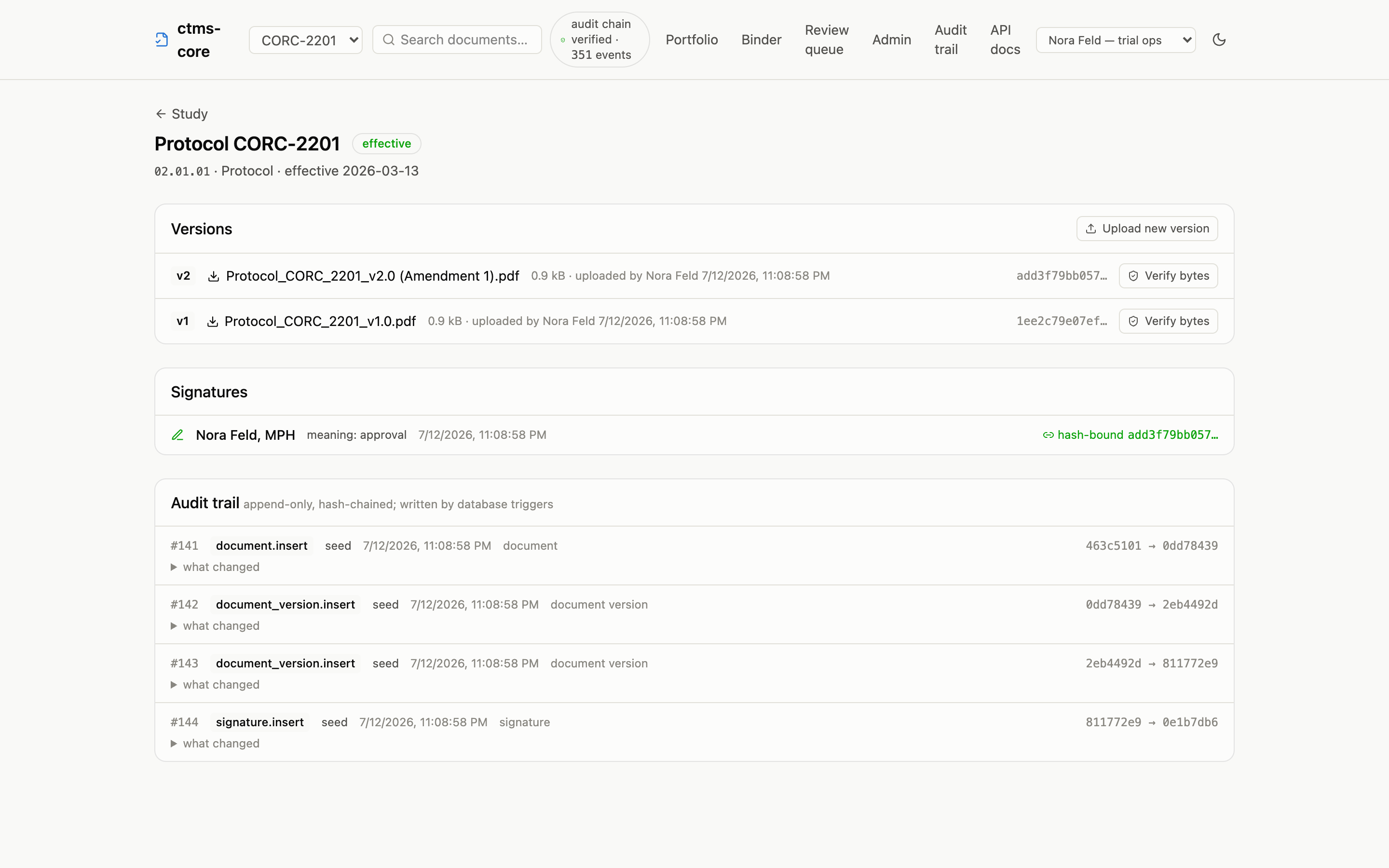
| §11.50 signature manifestation | Signature rows carry signer, timestamp, and meaning (author/review/approval); the UI displays all three |
| §11.70 signature/record linking | Each signature stores a copy of the signed version’s content hash, so the binding is verifiable independently of the version row. The web demonstrates it on demand: “Verify bytes” re-fetches the version’s content, recomputes SHA-256 in the reader’s browser, and compares against the recorded hash and every signature bound to it (ADR-0028) |
| §11.200 signature components | Signing requires re-authentication: in OIDC mode a freshly issued token for the same subject within a short freshness window; method and time are recorded on the signature row, and a database CHECK requires them on every new signature. Bulk approval is a §11.200(a)(1)(i) series of signings: one re-authentication opens the series, and every version still gains its own recorded signature |
ICH E6(R3): essential records
E6(R3) (final January 2025) reframes “essential documents” as “essential records,” with explicit expectations of version control, identifiability, and accessibility, language that favors a records-as-data design over folders-of-PDFs.
| Expectation | Mechanism |
|---|---|
| Records identifiable, version-controlled | Typed by TMF RM artifact + scoped identity; monotonic immutable versions |
| Completeness of essential records | Requirement rules + v_expected_document_status: expected-vs-actual is continuously computed, per site and per person |
| Access, availability, readability | Relational queries + a documented API; records retrievable by identity, not folder-path memory |
| Records protected from unauthorised alteration and from inappropriate destruction or accidental loss (2.12.9, 3.16.1(v)) | Database-level immutability; deletes of domain rows are themselves audited events |
| Protection of blinding / privacy when sharing | Out of scope this phase (single-tenant demo; no blinded roles yet) |
What this looks like in the product
Every document page shows the three mechanisms side by side: immutable versions with their content hashes, signatures displaying signer, meaning, and timestamp (§11.50) with the hash they are bound to (§11.70), and the trigger-written audit trail with each event’s link in the hash chain.
Try the mechanisms yourself
The claims above are testable from a terminal:
# Walk the hash chain end-to-end
curl -s http://localhost:8787/audit-chain/verify \
  -H "Authorization: Bearer dev-admin-token" | jq

# Try to rewrite history (the database refuses, regardless of role)
docker exec -i ctms-core-db-1 psql -U postgres -d ctms \
  -c "UPDATE audit_event SET action = 'nothing happened' WHERE id = 1;"
# ERROR: audit_event is append-only
The automated test suite includes DB-level immutability tests that attempt exactly these mutations and assert they fail.
Honest gaps (current phase)
- The validation program is not performed. The software generates its raw material (traceability matrix, IQ and OQ reports), but a CSV dossier also needs SOPs, risk assessment, training records, and a QMS to live in. That is organizational work no repository can contain.
- Dev mode still exists.
AUTH_MODE=devand the dev-grade database role passwords are demo affordances. A pilot must runAUTH_MODE=oidcand rotate role credentials (see the deployment checklist in the repo’sdocs/05-deployment.md); nothing in the code forces that choice. - WORM depends on deployment. The s3 storage driver with Object Lock extends immutability to the document bytes; the default local-directory driver does not.
pnpm validation:iqflags which one an environment runs. - Single tenant. One deployment per customer; multi-tenancy hardening remains a non-goal of this phase.
expected_documentchurn is unaudited by design. Placeholders are derived state; the ground truth they derive from is fully audited. The same stance covers extracted search text (ADR-0022), OCR of scanned pages included (ADR-0031): rebuildable at any time from the immutable, audited bytes.
Resolved since the first draft of this page: dev-token-only auth (now OIDC + RBAC), stubbed signing re-authentication, unblocked TRUNCATE (least-privilege runtime role), and the 40-artifact taxonomy ceiling (verbatim CDISC importer).