Quality control
Quality control decides whether a run’s results can be trusted. lims-core runs control materials alongside patient samples, evaluates each measurement against Westgard rules, feeds the verdict into the release gate, and gives the lab manager a board and a trend chart to review control performance over time.
Control samples and Westgard rules
Section titled “Control samples and Westgard rules”A control material is a sample with a known target and standard deviation run on a worksheet like any other. When a control measurement is recorded, the system converts it to a z-score (how many SDs from target) and evaluates Westgard rules against the control’s recent history:
- Single-point rules on one measurement — a 1-2s warning when a point lands beyond ±2 SD, a 1-3s rejection beyond ±3 SD (ADR-0019).
- Multi-observation rules that look back across the control’s prior points keyed on the same control material — for example a same-side 2-2s rejection when two consecutive points fall beyond ±2 SD on the same side (ADR-0023).
The verdict — accept, warning, or reject — is what the run-level QC gate
reads when deciding whether results may be released.
The QC review board and Levey-Jennings
Section titled “The QC review board and Levey-Jennings”The QC review screen is a read-only, lab-wide view of control performance. A board lists every active control with its latest verdict, the rule that fired, its z-score, and how many measurements back it. Below it, a Levey-Jennings chart plots one control’s measurements over time against ±1 / ±2 / ±3 SD bands, colouring each point by its verdict and annotating the rule at any rejection.
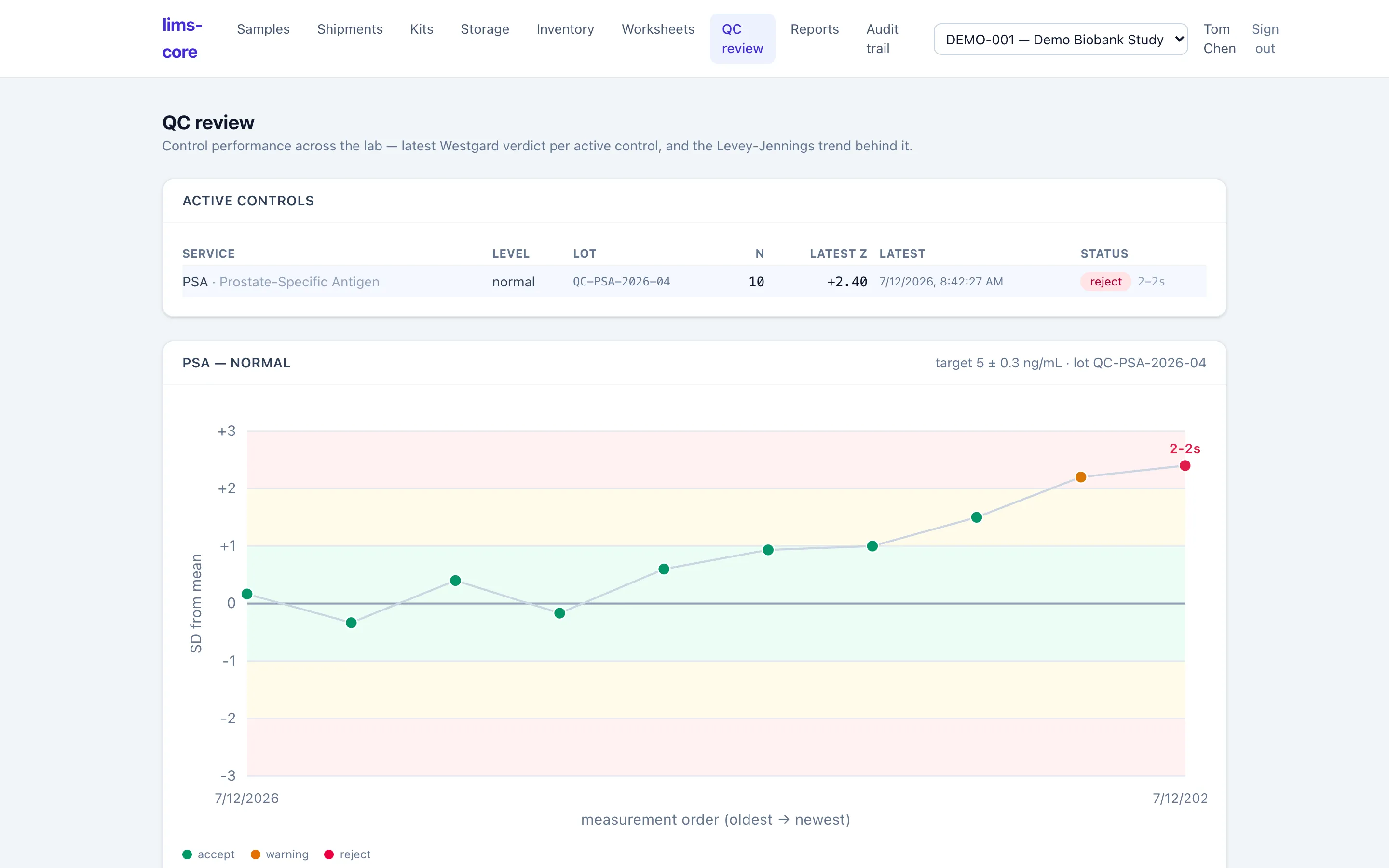
The chart reads the measurements exactly as recorded, in order, so what a reviewer sees is the same history the gate acted on — the drift that warned, then the point that rejected, are the same events, not a recomputed summary.