Orders and results
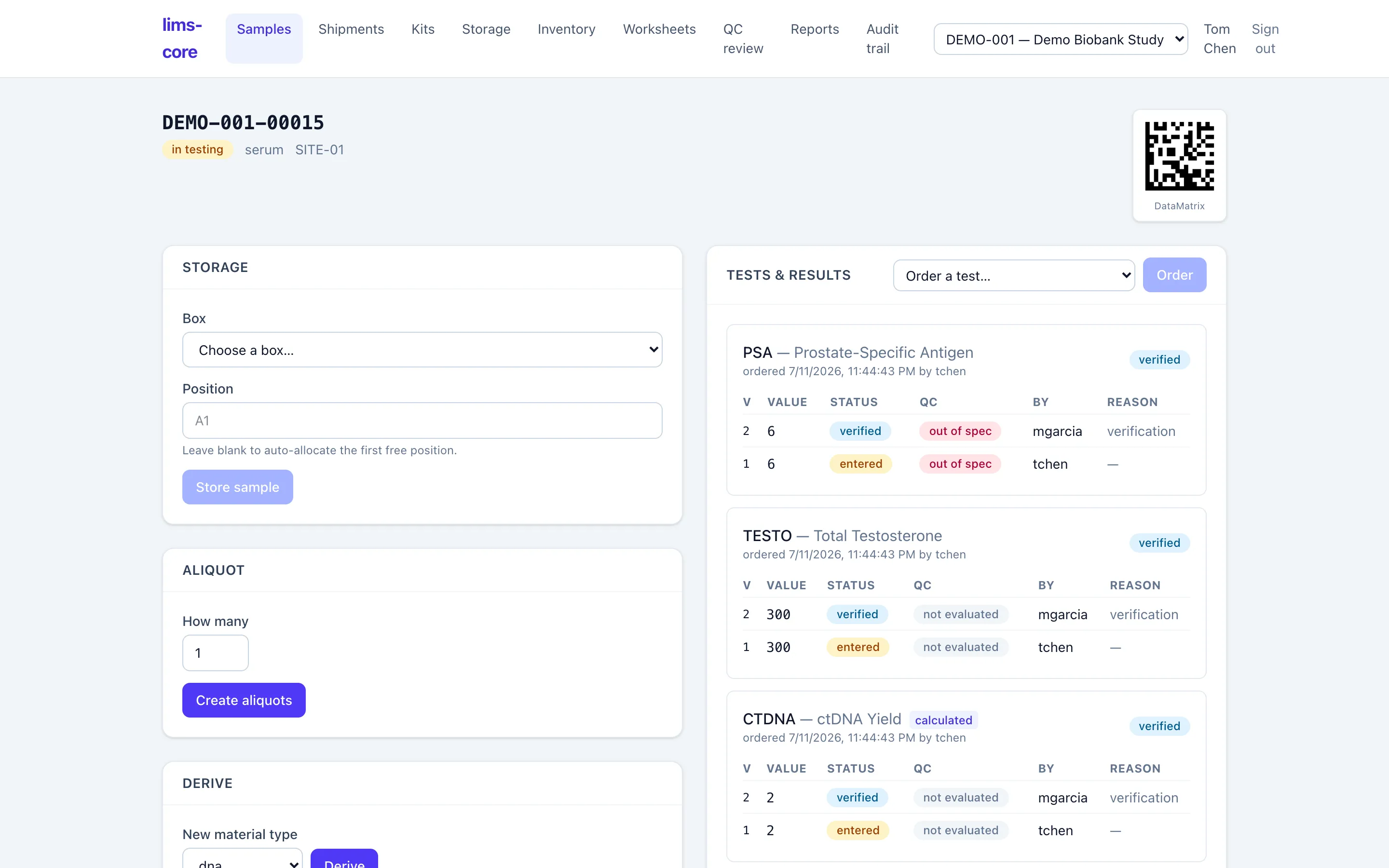
With a specimen stored, you can order a test against it and record the result. Results are the most tightly controlled records in the system: they are versioned, append-only, and cannot be released by the same person who entered them.
Ordering a test
Section titled “Ordering a test”Each study draws from a catalog of analysis services — a named test with a code and a unit (the demo study seeds Prostate-Specific Antigen in ng/mL, Total Testosterone in ng/dL, and ctDNA Yield in ng). Ordering one creates an analysis request against the specimen. The catalog is the same structure an analytical lab uses for its full test menu; here it carries the handful of tests the biobank workflow needs.
Entering a result
Section titled “Entering a result”Enter a value and its unit against an order. The result starts as an unverified version. If a result needs correcting, you do not overwrite it: entering a new value adds a version, and the server requires a reason for the change. The original value stays visible in the result’s history forever (requirement P11-02).
Specifications and QC status
Section titled “Specifications and QC status”A service can carry an acceptance criterion — a numeric range or a
qualitative expectation — versioned by supersession. When a result is entered,
the system evaluates it against the active specification and stamps a QC verdict
on the result: pass, out_of_spec, or not_evaluated (ADR-0017). The verdict
is visible in the result panel next to the value, so an out-of-range result is
obvious at entry rather than at release.
Some services are calculated rather than typed in: their value comes from a safe expression over other results on the same sample, evaluated server-side (ADR-0020). A calculated result is versioned and verified like any other.
Four-eyes verification
Section titled “Four-eyes verification”A result follows a four-eyes rule: the person who enters a result cannot verify their own work. A lab manager reviews it and verifies, and the verifier must be a different user than the enterer — the system rejects a self-verify. Verification is what promotes a result toward release.
Only a verified result can be released, and releasing it requires an electronic signature. Where results are produced in batches on an instrument run, the analytical testing page covers worksheets and the run-level QC gate that can hold a whole run’s results back.