Biobank operations
A biobank rarely stores a specimen and leaves it alone. It splits it into working aliquots, derives new material from it, pools several specimens together, and sometimes has to pull one from circulation when consent is withdrawn. Each of these actions runs from the sample record, and each writes its own lineage and custody so the physical history stays complete.
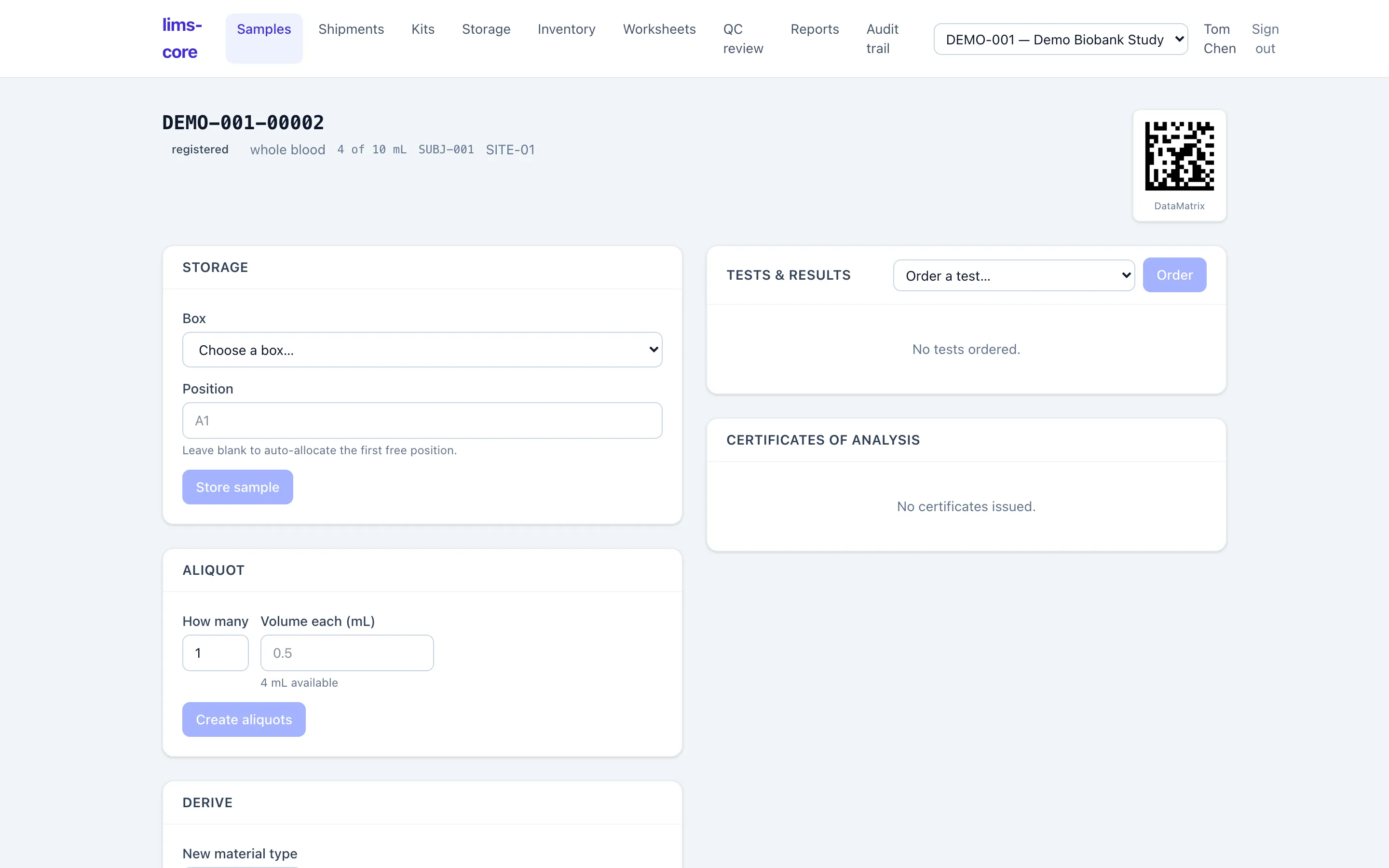
Aliquots and volume
Section titled “Aliquots and volume”A specimen can carry a tracked quantity (for example, 10 mL of whole blood).
Creating aliquots draws from that quantity: you say how many children and how
much each takes, and the volume is conserved — the parent is deducted by what
the children remove, and is marked depleted when it reaches zero (requirement
CoC-04, ADR-0006). Each child gets a parent-suffixed accession ID (like
DEMO-001-00002.1), a sample_lineage link back to its parent, and its own
aliquot custody event.
Specimens also track freeze-thaw count and concentration, so a record carries the handling detail an analyst needs to judge whether the material is still fit for an assay (ADR-0013).
Derivation and pooling
Section titled “Derivation and pooling”Two lineage shapes beyond simple aliquoting are supported (ADR-0014):
- Derivation produces a new material type from one parent — DNA from whole blood, say. The child is a different specimen type, linked to its single parent.
- Pooling combines many parents into one pooled sample, recording the many-to-one lineage. Start it with Pool on the samples list.
Both are audited in sample_lineage with matching custody events, so a derived
or pooled sample can always be traced back to every specimen that contributed to
it.
Consent-withdrawal holds and disposal
Section titled “Consent-withdrawal holds and disposal”When a subject withdraws consent, their material has to stop moving. A hold can be placed on a single sample or on a whole subject, and it propagates to every descendant in the lineage — aliquots and derivatives included (requirement CoC-05, ADR-0009). While a sample is on hold, the system blocks storing, aliquoting, and shipping it.
A hold is reversible: releasing it returns the sample to its prior status. Disposal is not — it is a terminal, supervisor-only action that ends the specimen’s life in the biobank, recorded as its own custody event. The separation is deliberate: an ordinary handler can hold, but only a supervisor can dispose.